


Vistalux corrugated PVC roofing sheets are a lightweight roofing and cladding material that are quick and easy to install. This guide will clearly break down how to fit these roof sheets for a lean-to or carport roof. If you’d like to check out the Vistalux guide we refer to in this article, click here to download the guide.
In addition to the PDF guide, the video below from Vistalux manufacturers, Ariel Plastics, follows a similar step-by-step installation of a carport project using the same techniques and tools.
Table of contents
- How to install Vistalux roofing sheets
- Getting started
- Cutting your PVC roofing sheets
- Drilling your PVC roofing sheets
- Installing the flashing
- Fixing the roofing sheets
- Additional checklist
- Final thoughts
How to install Vistalux roofing sheets
The Vistalux installation guide explains how to install PVC roof sheets on a carport or lean-to, but the instructions can be applied to porches, awnings, gazebos, and sheds. They include a list of the tools and materials you’ll need, a checklist, and important warranty details.
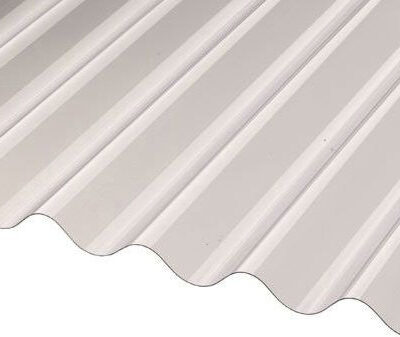 Here are the basic steps for installation:
- Gather all the required materials
- Arrange the sheets loosely and cut to size
- Drill the sheets ready for fixing
- Install wall flashing at the top of the slope
- Fix the roofing sheets in place
- Join the sheets end-to-end with an overlap
Below is a more in-depth outline.
Getting started
Before you begin installation, it is important to note that you need a roof pitch of at least 5 degrees in order to ensure suitable water runoff. However, for optimum drainage, it should preferably be over 10 degrees.
Now make sure you have all of the following Vistalux products:
- PVC roofing sheet
- PVC wall flashing
- PE eaves fillers
- Super fixings
- Flashing tape
Please note these steps do not include instructions on how to build the frame for the sheets to fit on to.
Cutting your PVC roofing sheets
Once your timber frame is built, you can now prepare to cut your PVC sheets. It is important not to cut these in cold temperatures, as it can lead to damage. Store them in a warm room before cutting if possible.
- Loosely place your PVC sheets on the roof frame
- Make sure they overhang by a minimum of 60mm. This will guarantee water will run off of your canopy into nearby gutters
- Ensure the PVC sheets are wide enough to cover the barge board at either side, still allowing the 60mm overhang
- Mark any saw cuts or drill holes with a felt-tip pen
- At a shallow angle and applying light pressure, use an angle grinder with a metal slitting blade or fine tooth saw to cut your sheets to size
- Vistalux recommend to sandwich the sheet you are cutting between two other sheets, and ensure it is protruding
- If a sheet has to be cut to a finished width, make the cut in the slope, or ‘valley’, of the corrugated sheet
Drilling your PVC roofing sheets
It is important to pre-drill holes in your Vistalux PVC roofing sheets before fixing. You must make sure the hole is bigger than the fixing itself to allow for expansion during different climates. As an example, on a 3m sheet you’d want to make the hole around 10mm.
- Drill sheets one at a time
- Use a masonry drill bit
- Use a low-speed drill, applying light pressure
- Support the sheet securely from the bottom whilst you drill
- Vistalux recommends at least 5 fixings per support across the width of a single sheet
Installing the flashing
This is applied if you’re attaching your roof to a wall. Make sure you use the correct Vistalux wall flashing that is compatible with the corrugation of your roofing sheet
- Install at the top of the slope
- Use Butyl wall flashing tape to fix firmly into place
- This step creates a watertight seal between the PVC roofing sheet and the wall, preventing unwanted leaks and water ingress from rainfall
Fixing the roofing sheets
Vistalux recommend using their foam fillers under the roofing sheets at all support points to prevent noise from vibrations caused by wind, and to further solidify the structure.
- Use Ariel or Vistalux screws, caps, and washers to secure the roofing sheet in place
- The screw is tight and in place when you can rotate the washer under its head with your finger and thumb – it doesn’t need to be any more snug than this
Additional checklist
- Make sure any paints or preservatives are fully dry before fixing PVC roof sheets to avoid damage
- Vistalux recommend any surfaces of supports immediately under the sheets/that are visible are white
- Do not install false ceilings, insulation, or any other opaque material underneath fixed PVC roofing sheets, as it could cause temperatures to exceed 60 degrees Celsius and lead to discolouration or warping
- Only use clean soapy water and a soft cloth to clean your PVC roof
- Store PVC roofing sheets in a cool, dry place, out of sunlight and on a flat surface. If you cannot store them inside, place substantial tarpaulin over them to avoid discolouration from UV rays
Final thoughts
Please refer to the Vistalux guide attached at the beginning of this article for further details. At Roofing Superstore, we are confident you now have all the knowledge and tools to help you with your PVC roofing project from start to finish.
Browse the full range of Vistalux PVC roofing sheets and accessories available, including fixings, wall flashings, polyethene eaves fillers, adjustable ridge and sealing strips to match the various profile options.
If you’re unsure about measurements, fixings, or anything else concerning Vistalux PVC roofing sheets, please give our team a call on 01752 692 760, and we’ll even give you a free quote.

Was this guide useful?
Mentioned in this project guide: